The Sun is approximately 93 million miles away from Earth. Because the Earth's orbit is not a perfect circle, there cannot be an exact figure.
Tuesday, April 15, 2008


Tuesday, March 4, 2008
World's Largest Cactus
The world's largest cactus species is the Saguaro cactus. Pronounced "sah-wah-roh", it is native to the Sonoran Desert of southern Arizona, southeastern California, and northwestern Mexico.
The plant grows very slowly and can take up to 75 years to grow a second arm. The largest and oldest Saguaro have been estimated at nearly 200 years old and can reach heights of 40 or more feet (12 meters). However, the average old Saguaro has approximately five arms and is about 30 feet (9 m) tall.
Saturday, February 23, 2008
World Population
According to the U.S. Census Bureau, as of this post, the world's population is approximately 6.65 billion, and the United States population is approximately 303.5 million.
I did some checking around, and this seems to fit the general consensus.
Here's another cool "World Clock" that has lots of random information.
Saturday, February 16, 2008
How Can I Lower My Blood Pressure?
For most of us, it's common knowledge that a diet high in sodium can lead to high blood pressure or hypertension. So the obvious answer to help lower your blood pressure would be to reduce your sodium intake. However, something most people don't know is that increasing the amount of potassium in your diet can be just as big a factor in lowering your blood pressure. Tobacco, alcohol, and stress have also been shown to increase your risk of high blood pressure or hypertension.
Some potassium rich foods are: bananas, citrus fruit, dried apricots, fish (especially salmon, flounder, and tuna), green leafy vegetables, legumes, melons, potatoes, poultry, tomatoes, whole-grain cereals, and yogurt. So stock up on potassium-rich foods to help push your blood pressure down.
While getting the right amount of potassium provides positive health benefits, too much potassium can be dangerous. Some people are more sensitive to how potassium affects their body. It's always a good idea to slowly work your way into a new diet. As always, before making big changes to your diet or increasing your intake of potassium, check with your doctor first.
Click HERE to see a more detailed explanation of how potassium affects your health, courtesy of Colorado State University.
Tuesday, February 12, 2008
How Much Does Water Weigh?*
1 liter of water weighs 1 kg, or 2.2046 pounds.
To get the weight for a gallon of water is easy. Since 1 liter = 1 kg, and there are 3.7854 liters in a gallon, then a gallon of water weighs 3.7854 kg (8.3454 pounds.)
Depending on your rounding you may end up with a slightly different answer. Typically 8.34 - 8.36 pounds (3.7829 - 3.7920 kg) in a gallon is a respectable number.
However, the general consensus is that a gallon of water is 8.34 pounds (3.7829 kg).
Here are a couple of links for the people that want to see the math:
Link 1 Link 2
Monday, February 11, 2008
Liters and Gallons*
1 Liter
Standard
= 0.2642 gallons
= 33.8140 fluid ounces
= 1.0567 quarts
= 2.1134 pints
= 4.2268 cups
Metric
= 1,000 ml
= 1,000 cc
1 Gallon
Standard
= 128 fluid ounces
= 4 quarts
= 8 pints
= 16 cups
Metric
= 3.7854 liters
= 3,785.4118 ml
= 3,785.4118 cc
Thursday, February 7, 2008
Who doesn't use the metric system?
Currently, there are only three nations worldwide that do not use the International System of Units (the metric system) as their primary or sole system of measurement. The three nations are: the United States, Liberia, and Burma.
Monday, February 4, 2008
The Eiffel Tower
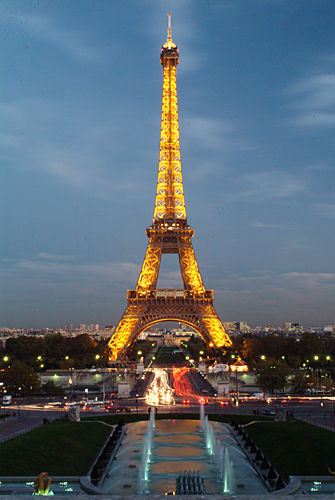 Located in Paris, France, the Eiffel Tower is 1,063 feet (324 meters) tall, including the antenna/flagpole. It was designed by Gustave Eiffel and was completed on March 31, 1889. The tower was built as the entrance arch for the Exposition Universelle, a World's Fair, that marked the centennial celebration of the French Revolution. Construction began in 1887 and took 2 years, 2 months, and 5 days to complete.
Originally the tower was met with resistance from the public, with many pointing to its ugly appearance. It was planned to be a temporary structure, being torn down after 20 years. However, the military discovered it to be a valuable asset aiding in radio communication, thus allowing the tower to remain.
Today the tower is one of the most recognizable structures in the world, and is considered by many to be a magnificent work of art.
Now that was the easy part. To my surprise, it was much harder to track down the following figures. So to keep the integrity of my blog intact, I must offer a disclaimer for the following "facts", as they may not be exact. I'm hesitant to even include them, as I could not definitively find an answer. With that being said, this is the best I could come up with:
The height of the actual tower excluding the antenna/flagpole is 986 feet
(300.65 meters).
The highest public observation deck is 906 feet(276.1 meters).
Change for a dollar? Sorry.
If you have three quarters, four dimes, and four pennies, you have $1.19. This is the largest amount of money in coins that you can have without being able to make change for exactly one dollar.
Monday, January 28, 2008
How many keys on a piano?
A standard full piano has 88 keys. 52 white or "natural" keys, and 36 black keys, which can be "sharp" or "flat" depending on if the note is high or low. This makes a total of seven full octaves plus a minor third, from A0 to C8
Musically speaking, a sharp is a note that is one half step higher than its natural note. Likewise, a flat is a note that is one half step lower than its natural note.
However, the two terms are also used in general when tuning instruments. If you are sharp you are out of tune on the high side, and if you are flat you are out of tune on the low side.
Friday, January 18, 2008
First Four Minute Mile
In athletics, the four-minute mile refers to the running of a mile in under four minutes.
The first four-minute mile was ran by Roger Bannister on May 6, 1954. He ran it in a time of 3 minutes 59.4 seconds. This historic athletic achievement took place during a meet between British AAA and Oxford University at Iffley Road Track in Oxford. It was watched by about 3,000 spectators.
Currently, the mile record is held by Hicham El Guerroui, who set a time of 3 minutes 43.13 seconds in Rome in 1999.
Oddly enough, no woman has yet to run a four-minute mile, although it is thought to be physically possible. The current women's record holder is Russian Svetlana Masterkova, with a time of 4 minutes 12.56 seconds.
Highest Point in the United States
The highest point anywhere the United States is Mount McKinley, Alaska, measuring in at 20,320 feet (6,194 meters).
The highest point in the lower 48 states is Mount Whitney, California, which comes in at 14,505 feet (4,421 meters).
I found a cool map from Geology.com that shows the highest point for each state. Click HERE to see it.
Subscribe to:
Posts (Atom)